The Hidden Compliance Risk Sitting Inside Your Software Connections
The riskiest part of cannabis compliance software often isn’t the software itself, it’s the invisible connections between systems. Here’s what actually goes wrong, and how to catch it before a regulator does.
Ask an operator what worries them about compliance, and you’ll usually hear about the rules themselves, changing THC limits, new reporting requirements, license renewals. Almost nobody mentions the actual place where compliance most often quietly breaks: the connection between two pieces of software that are supposed to be talking to each other.
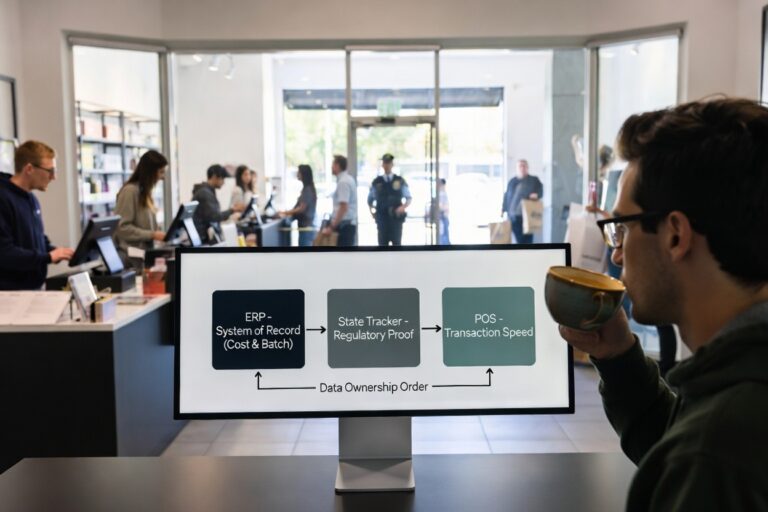
That connection is called an API (Application Programming Interface), and it’s easiest to picture as a translator standing between two systems that don’t speak the same language. Your point of sale system speaks one dialect. Your state’s tracking system speaks another. The API’s whole job is passing messages back and forth accurately, in real time, without dropping anything.
Most of the time, this works fine and nobody thinks about it. The problem is what happens on the days it doesn’t.

Where the actual failures happen

Timeouts during high volume periods. If your API connection is built to handle a normal Tuesday’s transaction volume, a busy 4/20 or a holiday rush can push it past its limits. When that happens, some systems silently drop the failed transmission rather than flagging it, which means a sale happened in your POS but never made it to your state tracker. Nobody notices until an audit finds the mismatch months later.
Mismatched data formats between systems. Your ERP might record a product weight in grams. Your state tracker might expect it in a slightly different format, or with a different rounding rule. A tiny formatting mismatch like this can cause a transmission to fail entirely, or worse, succeed with wrong numbers that nobody catches because the transmission technically went through.
Retry logic that isn’t actually checked. Most systems are built to automatically retry a failed connection a few times before giving up. That’s good design, in theory. In practice, operators rarely check whether those retries are actually succeeding, or whether the system just quietly stopped trying after the third attempt and never told anyone.
No real audit trail for the connection itself. Your POS probably has a sales log. Your state tracker probably has a compliance log. But the connection between them, the actual transmission of data, often has no separate record at all. If something goes wrong in that middle step, there may be no evidence showing when or why.
Why this matters more than it sounds like it should
None of these failures are dramatic. Nobody’s system crashes. No alarm goes off. That’s exactly the problem. A regulatory audit doesn’t care that your failure was quiet and unintentional, it cares that your records don’t match reality, and “our API had a timeout six weeks ago” is a much harder conversation to have after the fact than it would have been to prevent.
What to actually check, this week
You don’t need to become a software engineer to protect yourself here. A few practical steps go a long way.
Ask your POS and ERP vendors directly: what happens when a transmission to the state tracker fails? Not whether it can fail, everything can fail eventually, but specifically what happens next. Do you get notified? Does it retry automatically? Is there a log you can actually look at?
Pick a random week and manually spot check ten transactions across all three systems, the POS, the ERP, and the state tracker. Do the numbers match exactly? This takes maybe twenty minutes and it’s the single fastest way to catch a quiet integration problem before a regulator does.
Ask specifically about your busiest days. Every vendor’s system has a breaking point somewhere. Better to find out where that is during a calm week than to discover it during your busiest sales day of the year.

The takeaway
The riskiest part of a lot of cannabis compliance setups isn’t any single piece of software, it’s the quiet connective tissue between systems that nobody designed to be visible. Making that connection visible, even just with a simple weekly spot check, closes a gap that a lot of operators don’t know exists until it’s already caused a problem.
cannAItech explores practical future technology for regulated cannabis markets.