Cannabis ERP Explained for Operators
A plain, operator focused explanation of what cannabis ERP systems actually do, how they’re different from your POS, and how to shop for one without falling for a sales pitch.
Search “cannabis ERP software” and you’ll get a wall of vendor websites, every one of them convinced their platform is the one you can’t live without. What you won’t easily find is someone explaining, in plain terms, what an ERP (Enterprise Resource Planning, which is really just software that keeps track of everything your business owns, spends, and produces in one place) actually does, and how to tell if a given platform fits your operation before you sign anything.
That gap is worth closing. Switching ERP systems mid operation is expensive, and not just in dollars. It eats time and tests everyone’s patience in roughly equal measure.


What ERP actually means, without the sales pitch
An ERP exists to solve one basic problem: giving your business a single, reliable source of truth for inventory, costs, labor, and money, instead of five spreadsheets that all disagree with each other.
For a cannabis operation, that usually means:
- Tracking inventory and batches through cultivation, processing, and finished product
- Figuring out true costs tied to a specific batch, room, or production run
- Managing recipes (called a bill of materials) for anything you manufacture, like edibles or pre-rolls
- Handling purchase orders and vendor relationships
- Producing financial reports that actually roll up into normal accounting
- Feeding data to your state or national tracking system as inventory moves
Companies like Canix, Distru, PROTEUS420, and SilverLeaf all play in this space, each with different strengths depending on whether you’re mostly growing, mostly manufacturing, or doing a bit of everything.
Why ERP and POS are not the same thing
This mix up causes more headaches than almost anything else in cannabis tech, mostly because it leads to double data entry and sync errors that nobody notices until something’s wrong.
Your point of sale system (think Dutchie, Cova, or Flowhub) handles the customer facing side. Ringing up a sale, running a discount, managing your digital menu, and reporting that sale to your compliance system as it happens.
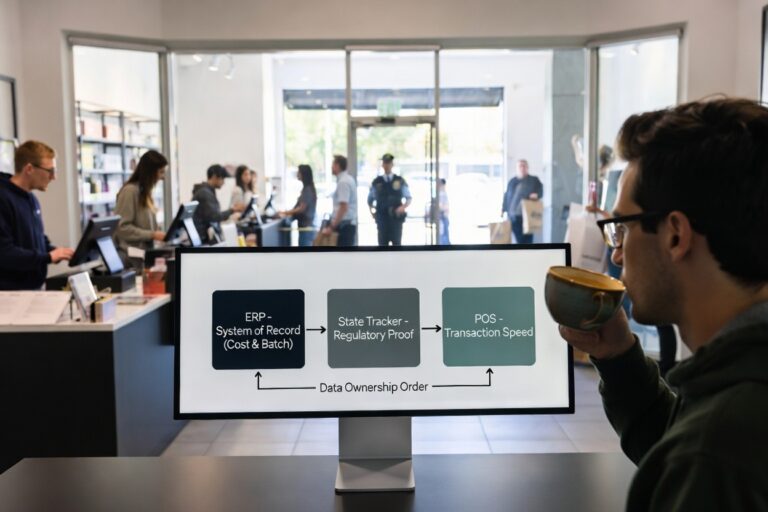
Your ERP sits one step back from that. It’s tracking what happened before the product ever reached a shelf. What it actually cost to grow or make, which batch it came from, and how all of that adds up to your real profit and loss.
Here’s a simple way to remember the difference. Your POS answers “what did we sell and to who.” Your ERP answers “what did it really cost us to have that thing to sell in the first place, and where did every unit actually go.”
A lot of operators assume their POS is tracking real costs. Usually it isn’t. POS systems are built for speed at the register and compliance reporting, not for detailed cost accounting across a multi step production process. That’s the exact hole ERP is meant to fill.


Where Metrc fits into all this
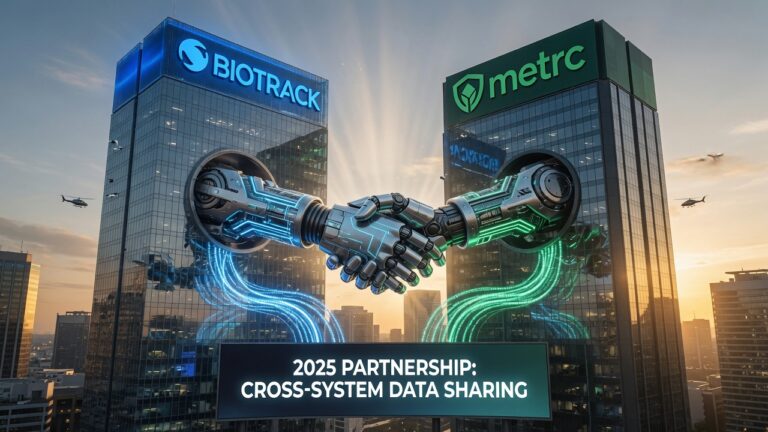
the regulatory layer, the system your state or country uses to watch plants and products move from seed to sale for tax and anti diversion purposes.
A well set up operation has all three talking to each other. The ERP holds the real cost and inventory truth, the POS handles customer transactions, and both feed the tracking system what it needs. When people complain about “compliance headaches,” the actual culprit is usually not the tracking system itself. It’s a messy handoff between ERP, POS, and the tracker that creates duplicate records or inventory counts that don’t match up, which is exactly what triggers an audit flag.
Worth knowing before you pick a platform, since your ERP and POS both need to play nicely with whatever tracking system your jurisdiction requires. A setup that works great with Metrc in one US state might need real reworking to satisfy Germany’s KCanG reporting rules or the Netherlands’ Justid system. The underlying philosophy behind each system is genuinely different (we get into that in a companion piece on European versus North American compliance setups).
What actually separates one cannabis ERP from another
Vendor marketing loves to list features. The differences that actually matter tend to be structural.
How well it handles vertical integration. If you grow, manufacture, and distribute, you need a system that can follow cost and inventory across all three stages without losing track of which batch came from where. Some platforms started as cultivation tools and bolted manufacturing on later. Others were built the other way around.
How it handles multiple states or countries. If you operate across state lines, or across different countries in Europe, your ERP needs to handle genuinely different rule sets without forcing you to run a separate, disconnected system for each one.
How detailed the cost accounting gets. Some platforms can break down labor and overhead costs down to a specific room or batch. Others only give you a facility wide average. If you’re trying to figure out your true cost per gram (a number most cultivators think they know and usually don’t), this level of detail matters a lot.
Whether it plays well with others. A closed system that can’t talk cleanly to your POS, your accounting software, or your state tracker is a recipe for exactly the duplicate entry problems mentioned earlier. Open connections and standard data formats should be near the top of your checklist, not an afterthought.

The question almost everyone forgets to ask
Before you get excited about features, ask what happens the day you want to leave. Data export options, contract terms, and whether your historical records actually come with you vary a lot between vendors. Getting locked into a system with no clean way out means you’ve traded a little short term convenience for a long term headache.
The best ERP for your operation isn’t necessarily the one with the longest feature list. It’s the one built around how your business actually moves product and money, with a clear exit if it ever stops being the right fit.
cannAItech explores practical future technology for regulated cannabis markets.