The Last Job in the Grow Room
Machines take routine cultivation tasks. The last worker becomes an exception handler, managing failures no robot can predict.
At 7 a.m., a cultivation worker starts a shift by walking the flower rooms.
She looks for a drooping plant, an emitter that stopped flowing, a branch that slipped out of the canopy, a patch of discoloration, a broken fan, water where water should not be, and anything else that feels different from yesterday.
Machines can already take pieces of that walk. Sensors can watch climate and root-zone conditions. Cameras can inspect plants. Controllers can water without a person opening a valve. Robots in horticulture can move through rows, treat crops with UV-C, pick fruit, and collect images. Cannabis-specific machines can trim, grade, reject, fill pre-rolls, and dose concentrates.
The workers are still there because the remaining jobs are the ones machines handle worst: unusual situations, delicate contact, maintenance, and judgment when the evidence does not agree.

7:00 a.m. The room walk
A fixed sensor sees one variable at one location. A person sees context.
Commercial cannabis platforms already collect temperature, humidity, substrate moisture, electrical conductivity, irrigation, and other facility data. Growlink now markets itself as an “Agentic Cultivation Platform” with AI agents and Copilot crop steering, and says its control endpoints can connect large language models to cultivation controls. Bloom Automation markets computer vision for plant-health tracking and early visual mold detection.
Agricultural robotics research published in 2026 adds mobility. The AGRI-BT project showed a simulated greenhouse robot taking natural-language inspection instructions, moving through rows, capturing images, and using a vision-language model for disease classification.
The inspection task is becoming automatable. The worker’s advantage appears when the room contains something the system was not trained to name.
A collapsed trellis, a strange odor, condensation on an unexpected surface, or a damaged irrigation line may be obvious to a person and absent from the machine’s categories.
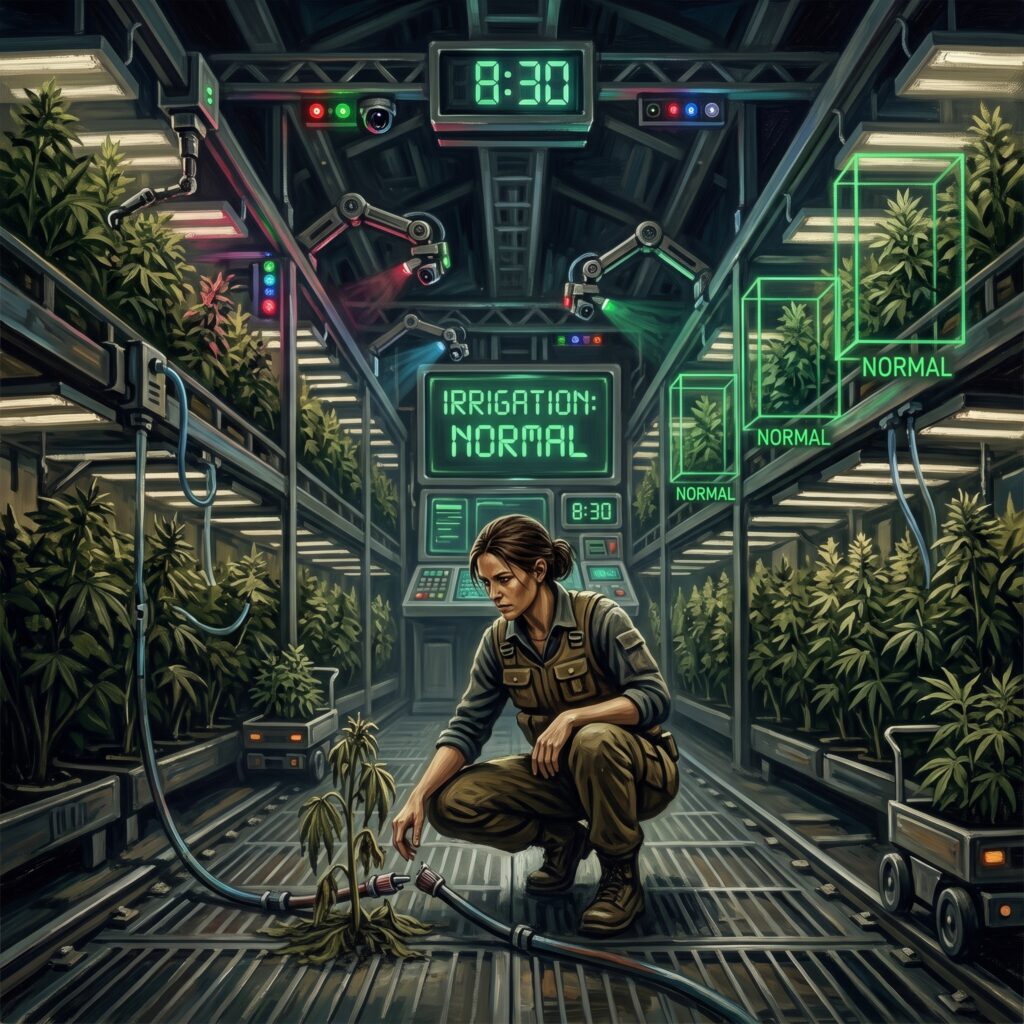
8:30 a.m. Irrigation
Routine irrigation is already one of the strongest candidates for machine control.
Priva, Hoogendoorn, Argus, and other control companies sell systems that can read sensors and operate irrigation equipment. Grodan supplies root-zone sensors that measure water content, electrical conductivity, and temperature in growing media.
The worker no longer needs to open every valve according to a clock. The controller can execute the irrigation strategy and record what happened.
The human remains responsible for the parts the control loop cannot guarantee. A clogged emitter can starve one plant while the room average looks normal. A moisture sensor can sit in a spot that is no longer representative. A pump can receive a command and fail.
Automation removes repetitive decisions first. It leaves exceptions behind.
10:00 a.m. Canopy work
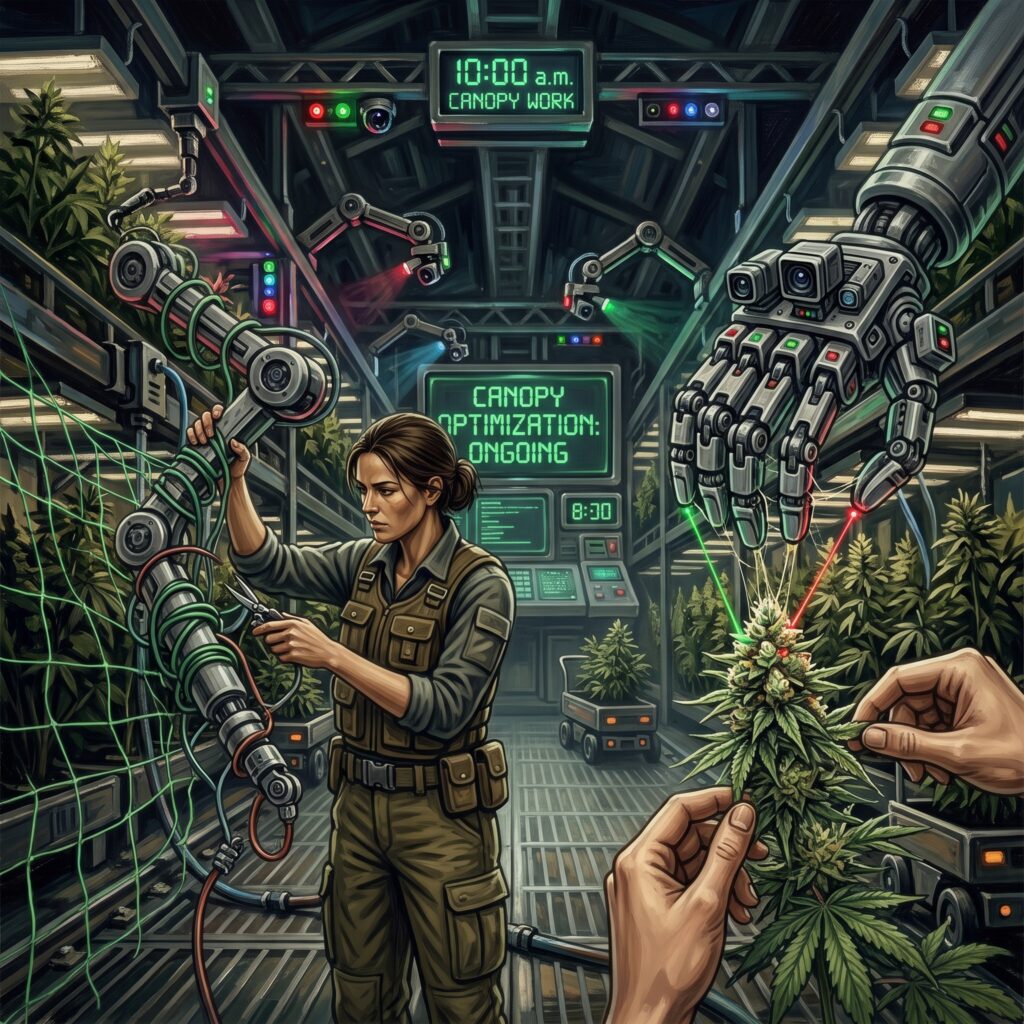
This is where the robots slow down.
Defoliating, training branches, moving trellis, inspecting crowded nodes, and handling a living cannabis plant require contact with a deformable object. The target moves when it is touched. Leaves overlap. Branches bend. The safe grip changes from one plant to the next.
Soft-robotics researchers are making progress with fragile fruit. A 2026 Nature Communications paper combined a five-finger soft gripper with vision, tactile sensing, and curvature sensing for adaptive fruit harvesting. Other research warns that soft grippers can still damage delicate biological products if force and contact are poorly controlled.
Cannabis adds exposed trichomes and sticky resin. A 2023 cannabis study found more detached or collapsed glandular heads in mechanically trimmed Pink Kush samples than in hand-trimmed samples.
No general-purpose commercial robot performs routine cannabis canopy work across cultivars at human quality today.
Noon. Scouting for trouble
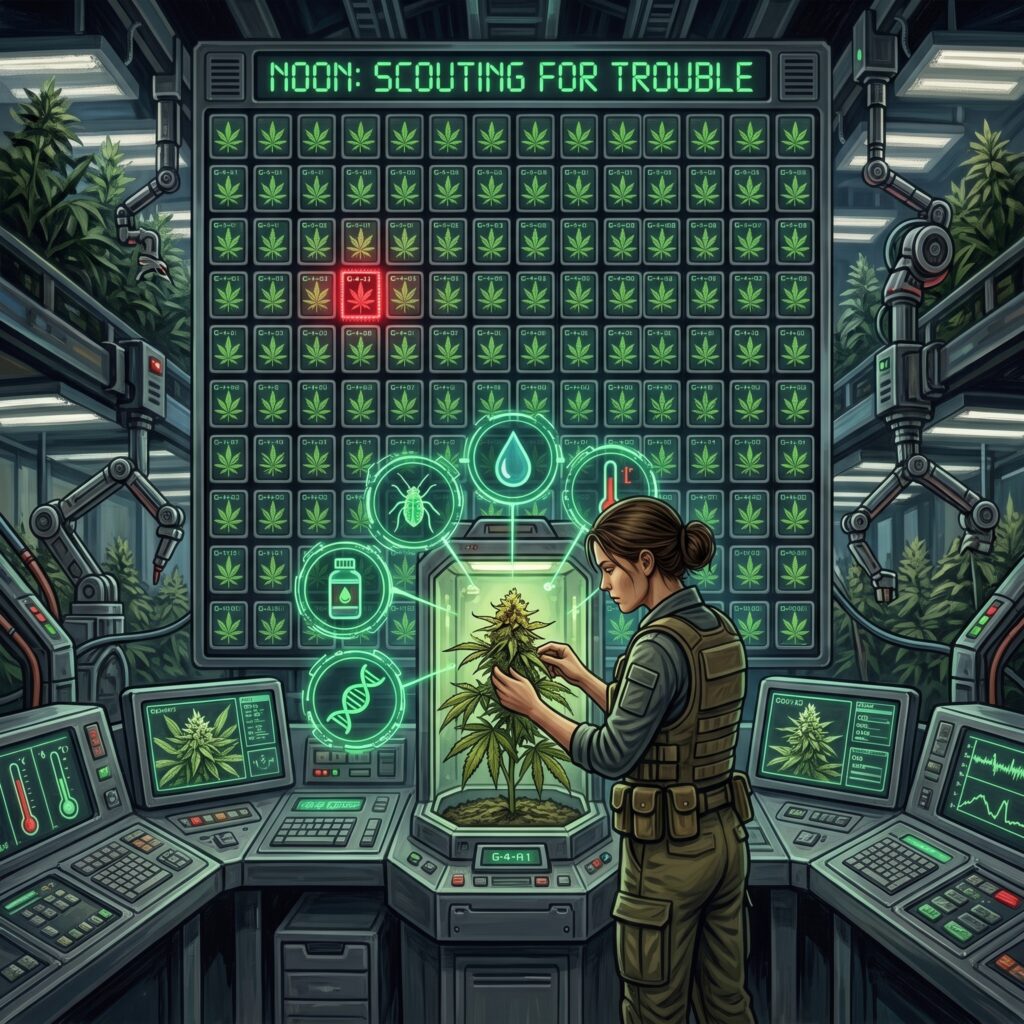
Cameras can compare plant images over time. Bloom markets cannabis-specific visual detection for poor plant health and mold. Research systems can classify disease images. Electronic-nose studies published in 2026 show that pest-induced plant volatiles can create machine-readable warning signals in other crops.
The first useful automated scout is an alarm generator, not a plant doctor.
It can say, “These plants changed,” or, “This area no longer looks like its neighbors.” A human can inspect the flagged zone, decide whether the symptom is pest pressure, irrigation, nutrition, heat, genetics, or something else, and choose the response.
When the diagnosis carries cost or crop risk, the gap between detecting an anomaly and understanding it matters.
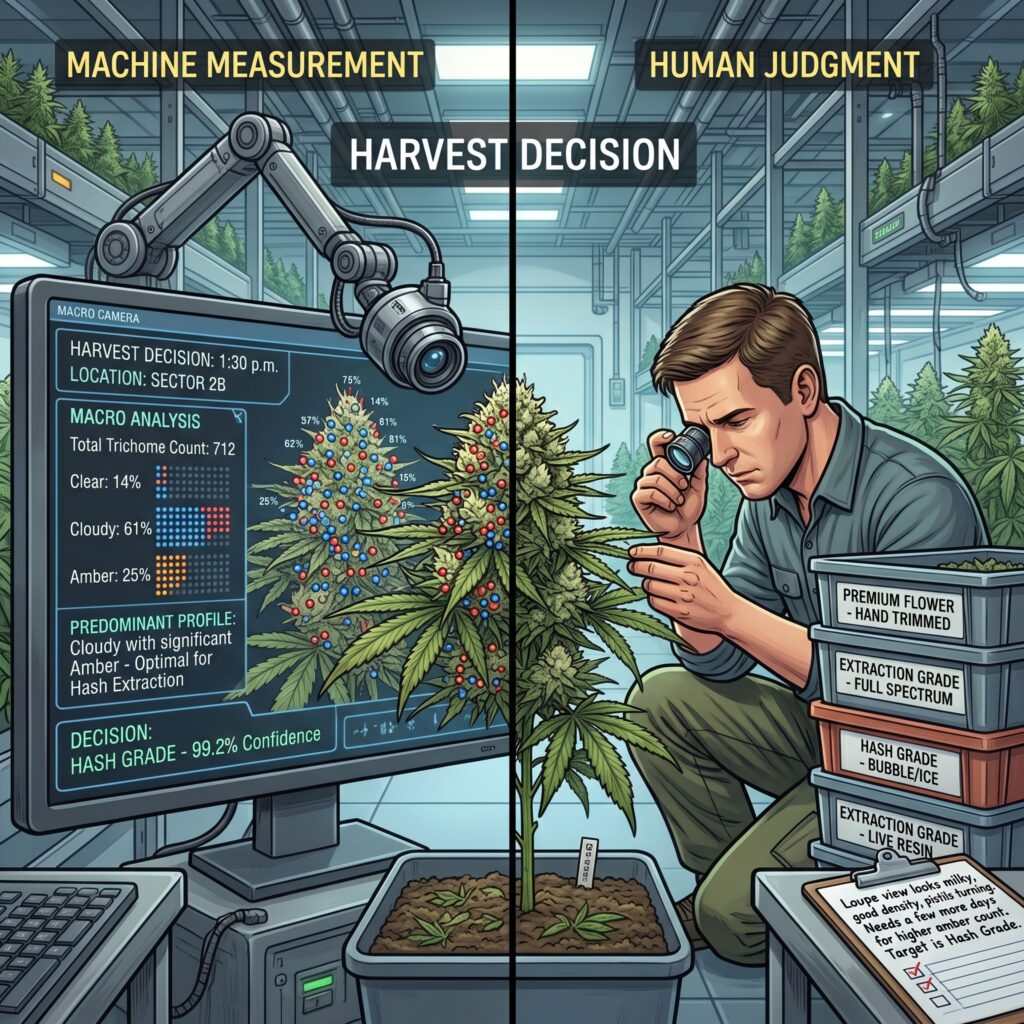
1:30 p.m. Harvest decision
A camera can now quantify part of a decision growers have long made by eye.
A cannabis-specific study published in February 2026 used over 14,000 macro images to detect trichomes and classify them as clear, milky, or amber. The researchers compared those visual markers with cannabinoid measurements and found relationships between maturity features and chemistry in their experiments.
The work does not prove that a camera can name the perfect harvest date for every cultivar. It shows that software can count and track visual maturity markers more consistently than an informal loupe check.
The worker’s role changes from counting what she sees to judging what the measurement means for the crop and production target.
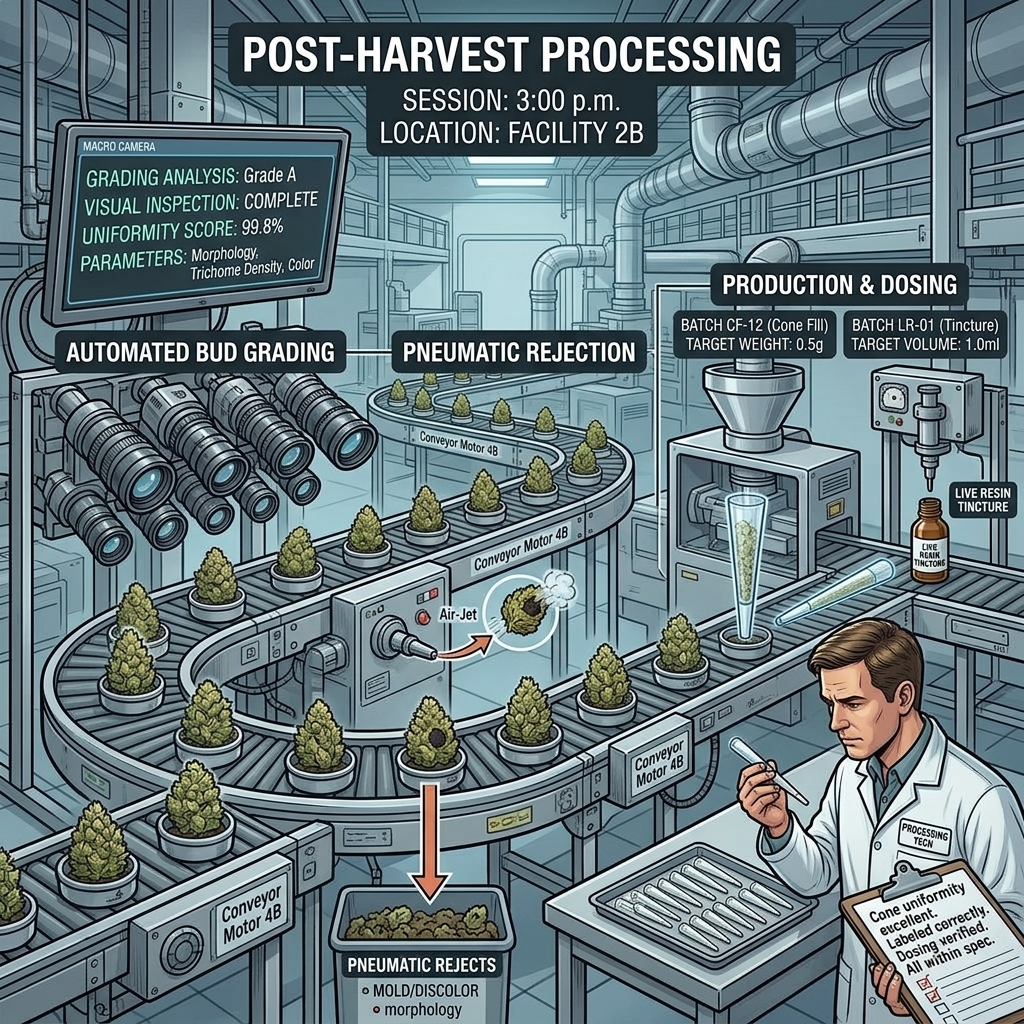
3:00 p.m. Post-harvest processing
Once the plant leaves the grow room, automation becomes easier because the process can constrain the object.
Bloom describes rejection sorting and grading as cannabis applications for its vision system. The company also says the same vision system can be combined with custom robotic work cells for tasks such as bucking and trimming, rather than presenting those tasks as separate shipping products. Sorting Robotics sells machines for filling pre-rolls, dosing concentrates, and coating finished products.
These machines do not understand the whole plant. They receive product in a defined stage and perform a defined job.
That is why factories automate faster than gardens. Conveyors create known positions. Fixtures hold product. Recipes control inputs. Cameras see the same background and lighting. A machine can repeat one movement millions of times without learning how to improvise around a living canopy.
The worker moves toward setup, quality checks, cleaning, supply, and exception handling.
5:00 p.m. Post-harvest processing
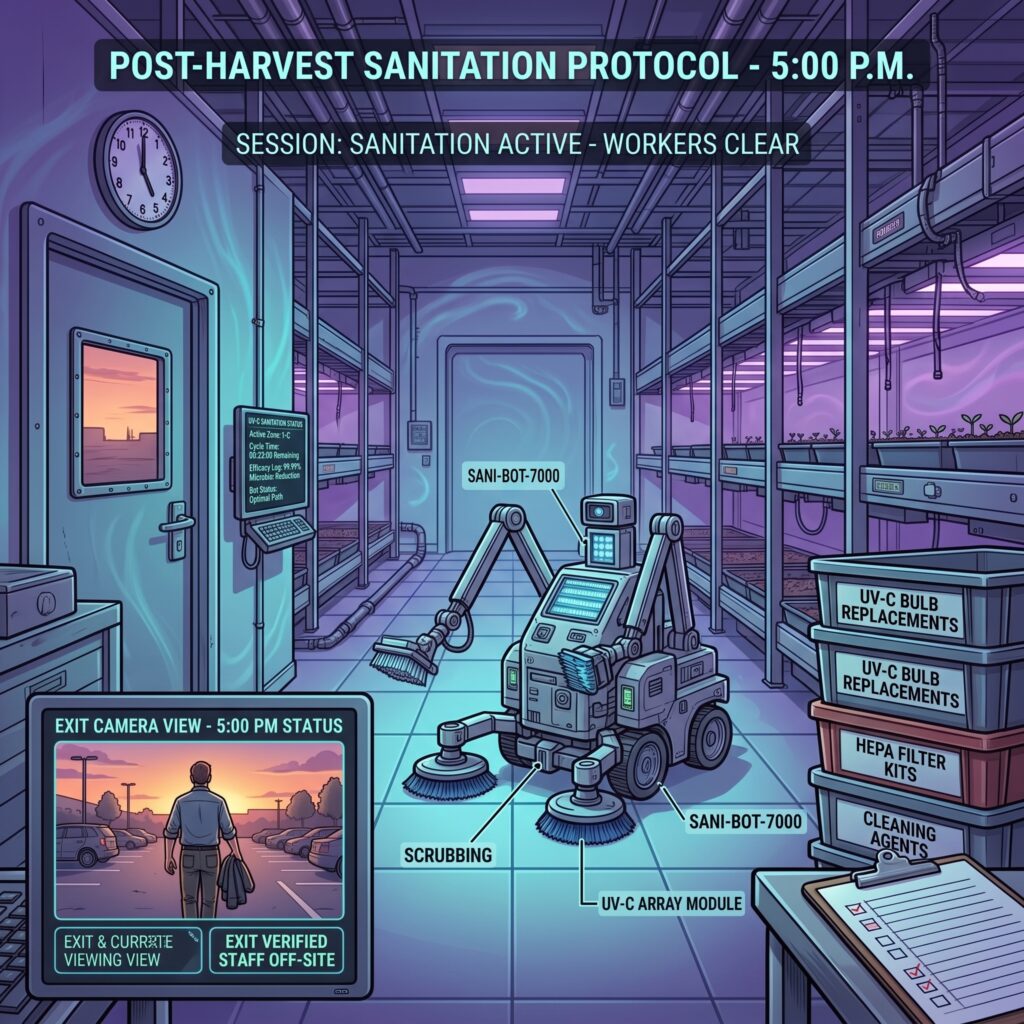
Automation gets another advantage when people leave.
Octiva and Saga Robotics sell autonomous UV-C crop-treatment machines for horticulture. Their robots move through rows while workers are absent, applying controlled ultraviolet light for disease suppression in crops such as strawberries and grapevines.
Cannabis-specific dose and crop-safety evidence is still missing, so those machines cannot be treated as proven cannabis treatment systems. They show that a repetitive nighttime route is a good robot job.
Cleaning floors, moving bins, transporting materials, and taking inventory have the same feature. The environment can be structured around the machine.
The closer the task gets to “move this known object from A to B,” the less the robot needs the broad judgment of a cultivation worker.
The last job is the exception
Machines are strong where the task has a measurable input, a defined rule, a repeatable physical action, and a clear way to check success. Water when the substrate reaches a threshold. Move to this coordinate. Capture this image. Reject a bud that falls outside a visual grade. Fill a cone to a defined process setting.
People remain strongest where the task changes shape while it is being performed or where the problem has no clean label.
The last worker in the grow room may therefore be less of a manual operator and more of a roaming exception handler. She handles the broken emitter that fooled the room average. She touches the branch the robot cannot safely grasp. She decides whether two weak signals point to disease or ordinary cultivar behavior. She repairs the machine that was supposed to remove labor.
That job can shrink as robots improve. It does not vanish because every new layer of automation creates equipment that also needs supervision.
Automation also creates work around the automation. Sensors need calibration, robots need cleaning and maintenance, and exceptions multiply when equipment behaves differently from its reported state. That means the supervision role can grow before it shrinks. The last worker is not only doing tasks no robot can perform. She is also handling the new failure modes created by the systems that took the routine work away.
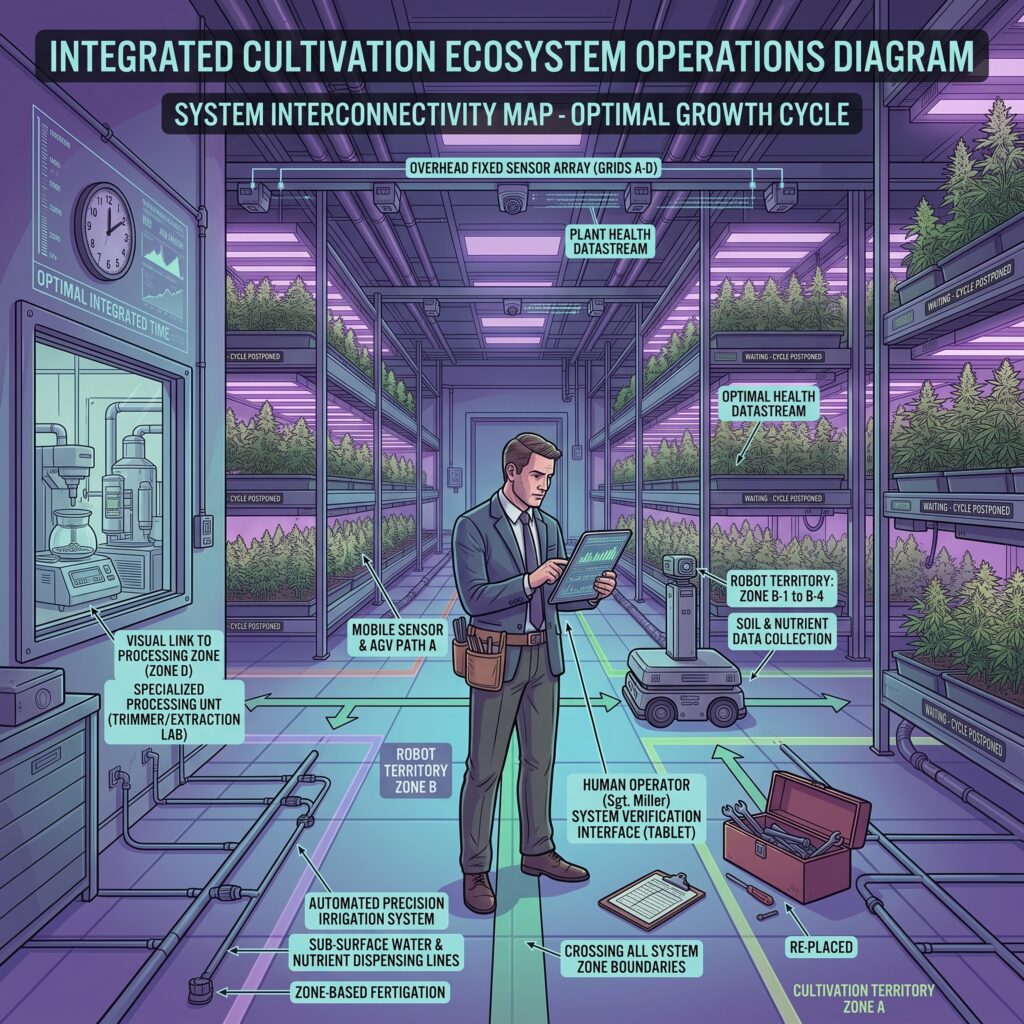
The grow room is becoming a mixed workforce
The near future is easier to picture when the focus shifts away from a date for replacing growers and toward the division of work.
A cultivation facility can divide work between fixed controls, cameras, mobile machines, specialized post-harvest equipment, and people. The machines take the repeated observations and repeated motions first. They can work overnight, keep records, and apply the same rule without fatigue. Humans handle uncertain evidence, fragile contact, unusual failures, and decisions that cross several systems at once.
The last job in the grow room is therefore not one old job that automation failed to remove.
It is everything the system was not trained to expect, and everything the equipment itself can break.
Sources
- Growlink, current Agentic Cultivation Platform, AI agents, Copilot crop steering, and control endpoints.
- Priva, Precision Irrigation Management.
- Grodan, GroSens Suite root-zone sensing.
- Bloom Automation, cannabis rejection sorting and grading applications, plus vision-guided robotic work-cell capabilities.
- Salman et al., “AGRI-BT robot: LLM-driven behaviour trees and VLM perception for intelligent autonomous greenhouse operations,” 2026.
- Lorberboym et al., “Estimating Cannabis Flower Maturity in Greenhouse Conditions Using Computer Vision,” Agriculture 16(4), article 460, February 2026.
- Punja et al., cannabis trichome morphology and handling study, 2023.
- Sorting Robotics, current cannabis manufacturing automation products.
- Octiva, Lumion autonomous UV-C robot.
- Saga Robotics, Thorvald autonomous UV-C platform.
- “Sensor fusion of touch & vision in soft manipulators for fruit picking,” Nature Communications, 2026.
This article reports the technology as it stood in Spetmeber 2026.
Editor’s note: The shift above is a composite of tasks documented by current cultivation systems and robotics research, not one named facility.