Robots Are Already Making Your Joints
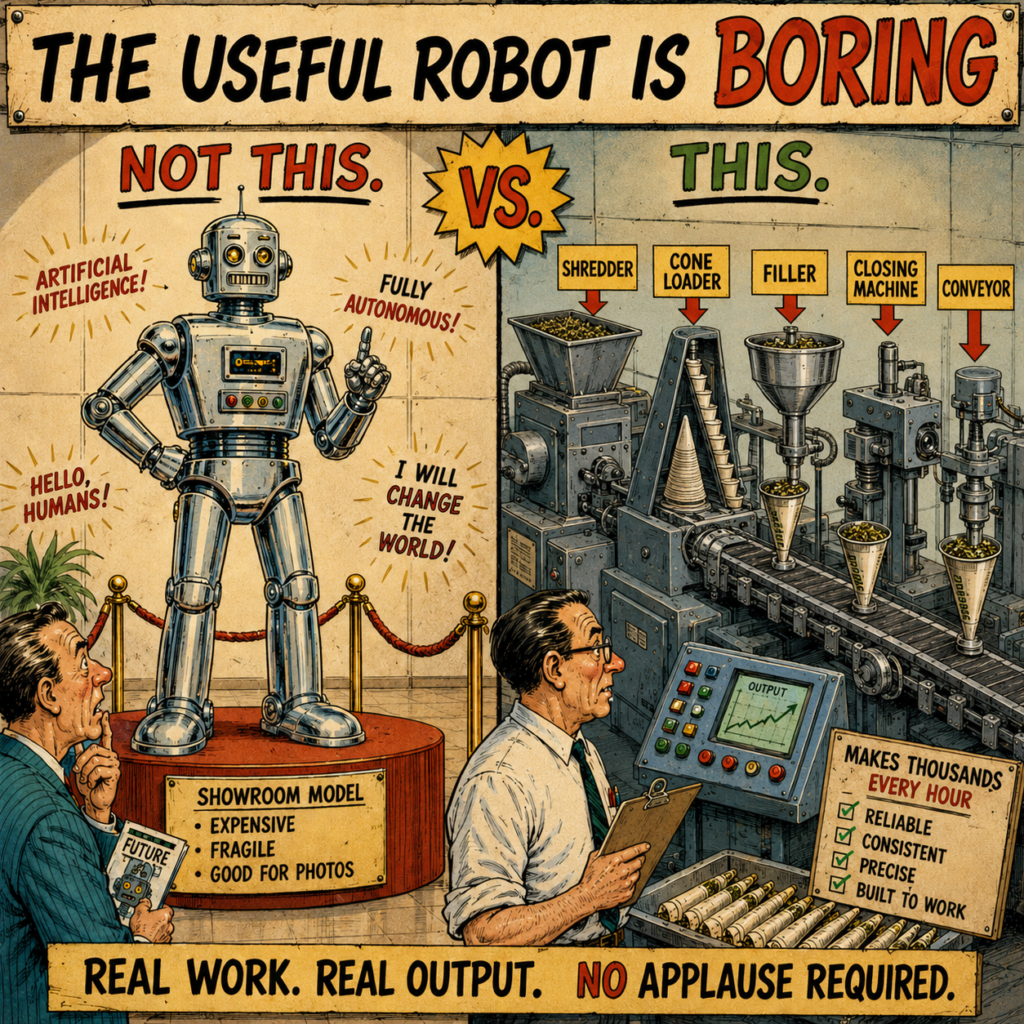
No, the robot does not sit at a table and roll a joint between two metal fingers.
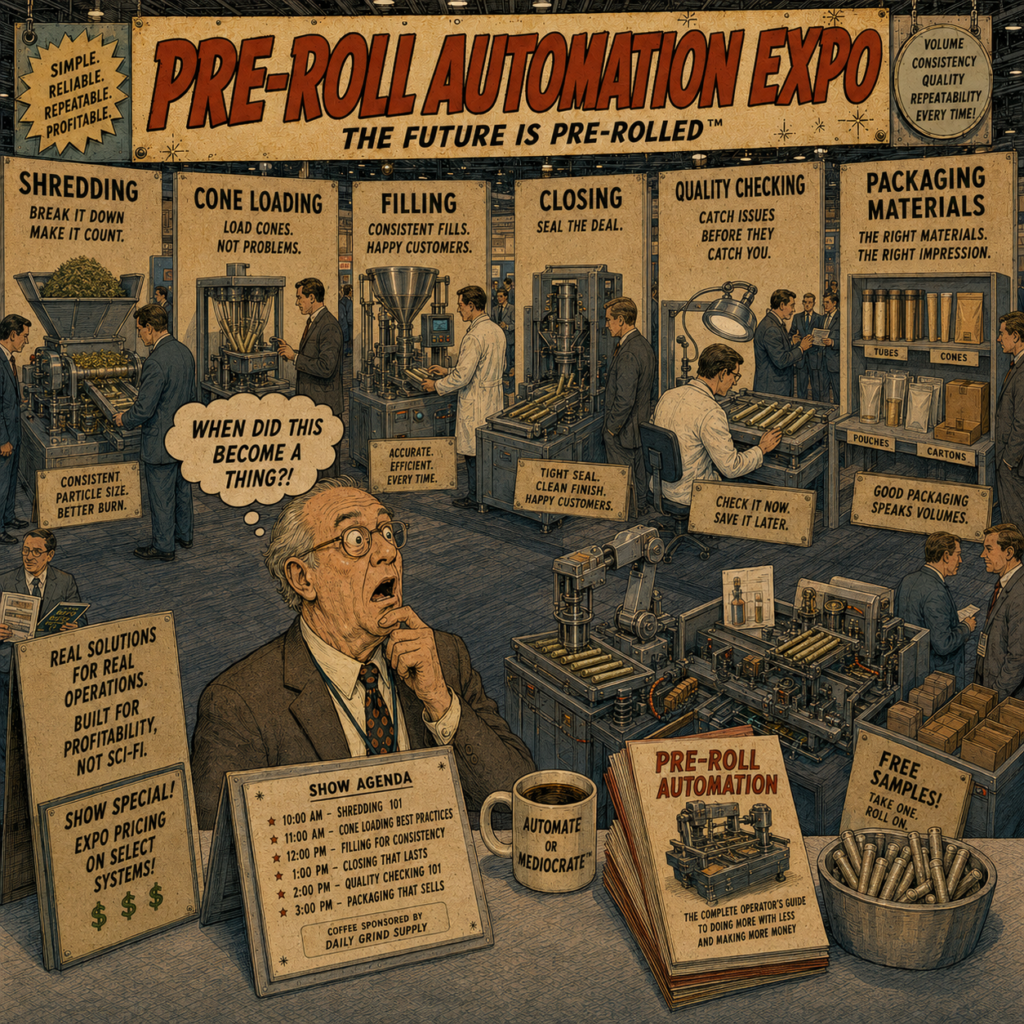
The real factory is less theatrical. Flower moves through specialized machines that prepare material, fill cones, settle the contents, close the finished pre-roll and send it toward packaging. The machine does not imitate a person’s hands. Engineers separate the work into jobs that can be repeated.
Futurola’s current Pre-Roll Production System is a useful example. The company connects shredding, material preparation, filling, cone loading and closing into one production workflow designed around two operators. Futurola says one two-operator line can produce more than 20,000 pre-rolls per day.
Pre-roll production has become a sequence of mechanical jobs that can be separated, measured and automated.
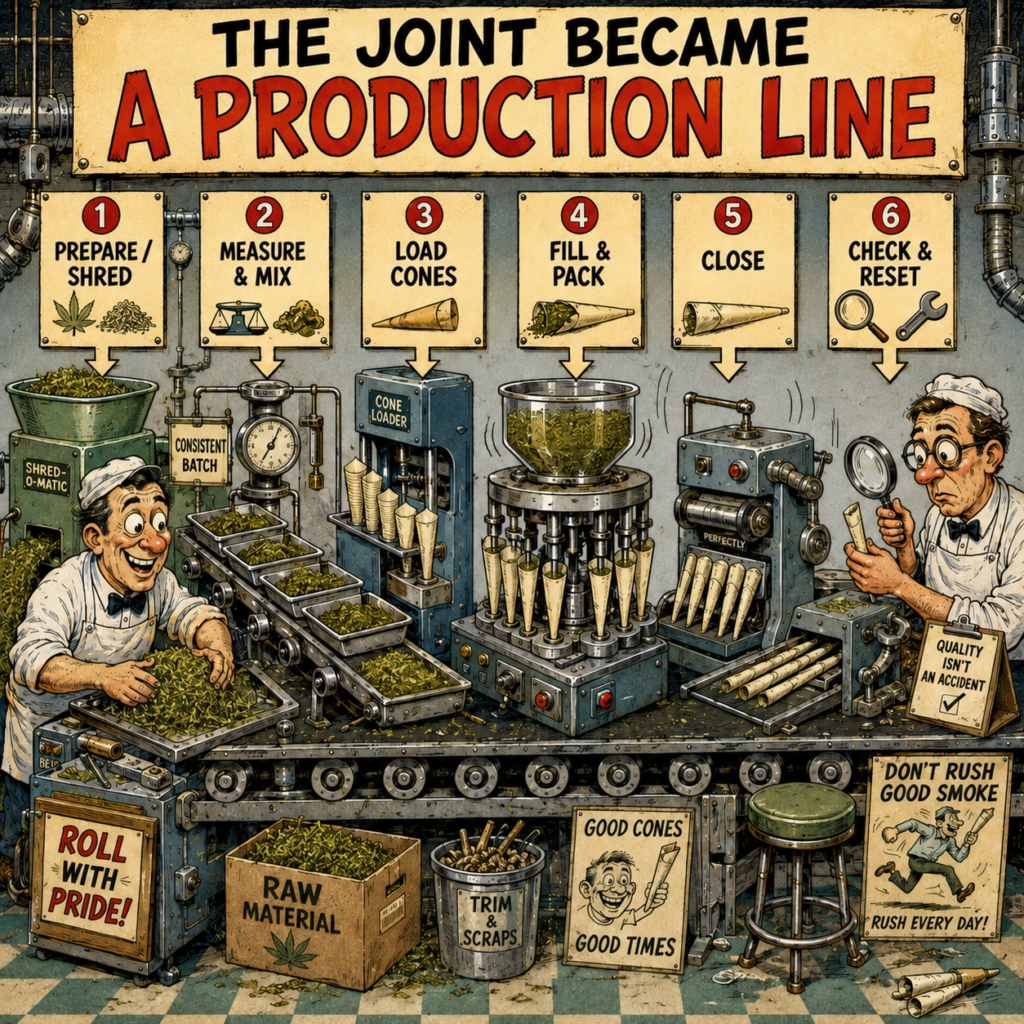
The joint became a production line
Hand production hides how many steps sit inside one finished pre-roll.
Flower has to reach the right consistency. A cone has to reach the filling station. Material has to be measured, distributed and packed to the chosen density. The filled cone then has to be removed, closed, checked and packaged.
A person can compensate by feel. A machine needs controlled inputs.
Futurola breaks its current production system into six operations. A shredder prepares the flower. Mix trays hold measured material for each cycle. The KnockBox 100 fills up to 100 cones per cycle with two packing-density settings. A cone loader handles the next set. The company’s Dutch Crown device closes up to 100 cones at once. The cones themselves form the sixth part of the system.
There is no single machine called ‘the joint robot.’ The automation is the line.
Separate machines prepare, fill and close the cones, while two people keep material moving through the process.
The robot in the cartoon has been taken apart and spread across the factory floor.
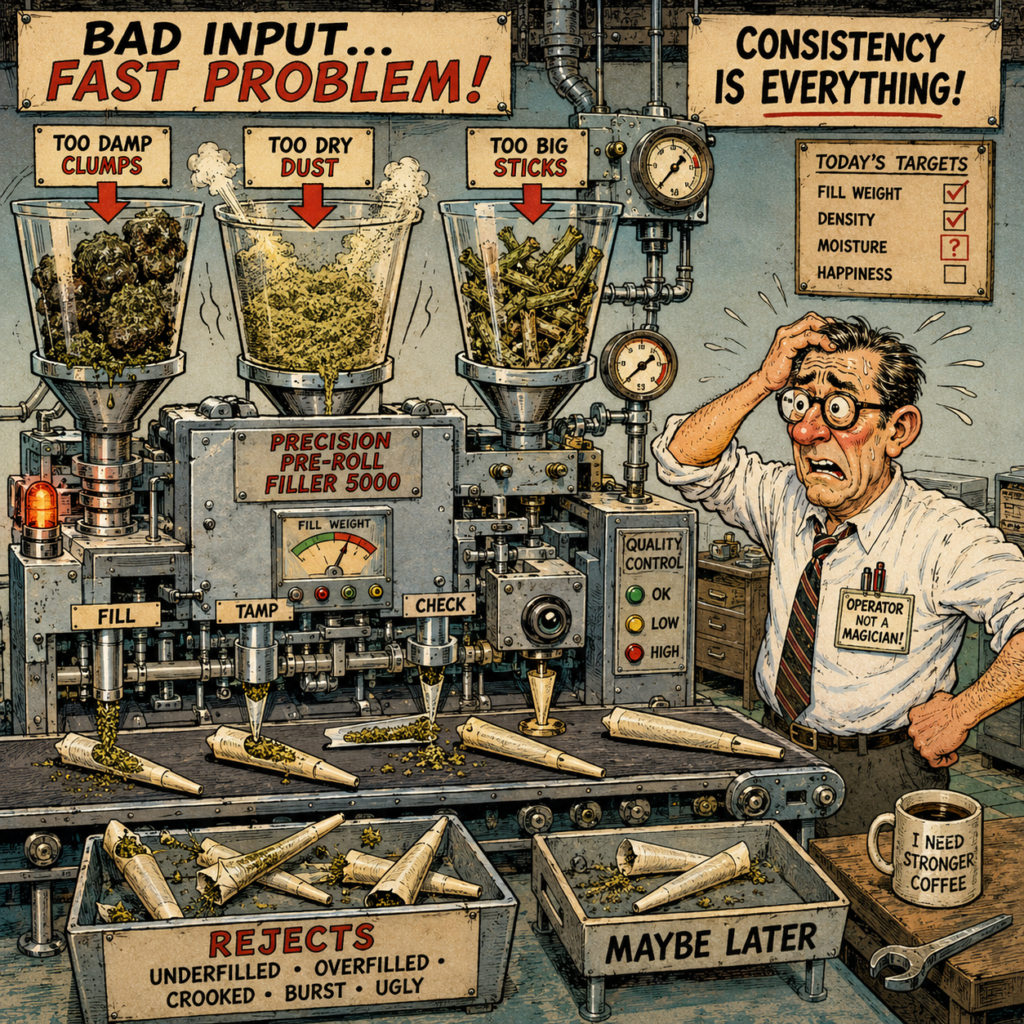
Automation does not rescue bad material
A pre-roll machine still receives cannabis, paper and a process.
Particle size matters. Moisture matters. Flower that does not flow consistently can behave differently inside filling equipment. A machine can repeat the same motion perfectly while receiving material that has changed.
There is experimental evidence behind part of that problem. A 2023 cannabis study tested joints produced with different particle sizes and found that particle size changed combustion behavior and cannabinoid delivery. The researchers also found substantial variation between replicates and concluded that the best particle size may differ between flower types.
A separate 2025 study examined cannabis flower at different water-activity levels, a measure closely related to how much available moisture the material contains. It found differences in chemical composition and smoking characteristics across the tested conditions.
Neither study was a factory-machine trial. Together, they support the basic production problem: cannabis flower does not arrive as a perfectly uniform industrial feedstock.
Futurola makes the same problem visible from the equipment side. Its current production material emphasizes uniform grind and repeatable density before filling. The company states that an inconsistent grind can undermine the next stage of production regardless of the quality of the filling equipment.
The cone adds another variable. Hara Supply says its manufacturing process includes a 13-step quality-control system. MaryJane Cones says every cone is inspected for consistency before shipment. Both point toward the same manufacturing requirement: the disposable part entering the machine has to be consistent too.
A poorly controlled input does not become good because the machine is fast. It becomes a poorly controlled output produced faster.
The interesting robot is not shaped like a person
Cannabis robotics is often illustrated with a humanoid standing over a table. The machines earning their place in production tend to look much less dramatic.
They are shredders, fillers, vibratory systems, conveyors, closing machines, cameras and handling equipment. Each does a narrow job and passes the product to the next stage.
That is normal industrial automation. Other vendors attack different stages of the same problem. Platform Robotics builds Softrim, which uses bladeless silicone-finger belts rather than cutting blades to strip leaf from dried flower, a different answer to the same question about how much force a bud will tolerate.
Futurola’s line still needs two people. One handles material preparation, mixing and filling. The second handles cone loading, closing and resetting the equipment for the next cycle. The company automates parts of the job rather than the entire production floor.
The repetitive movement is increasingly mechanical. Material judgment, setup, cleaning and exceptions still belong to people.
Precision is the job
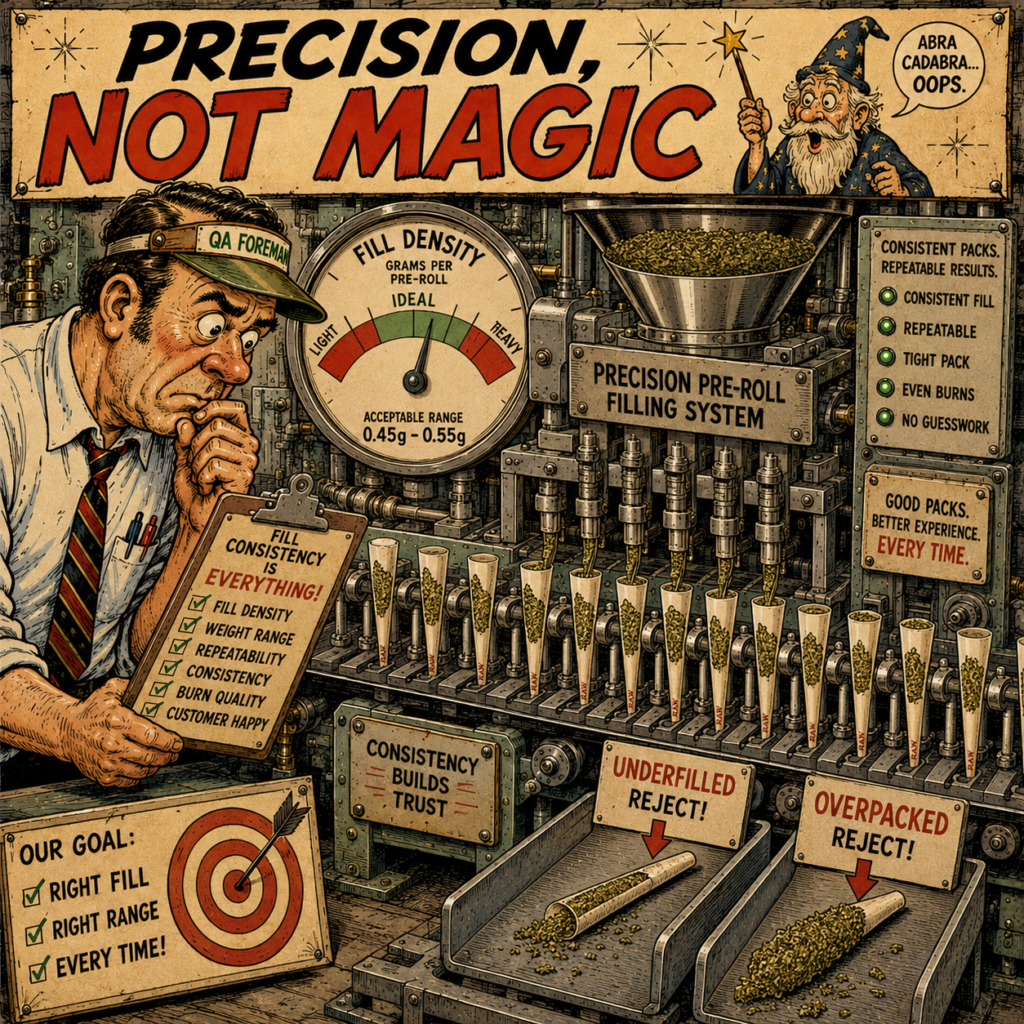
The design shows what the equipment is trying to control: repeatability from one cycle to the next.
Small variations repeat.
A little too much material in one cone may be a correction. The same error repeated through hundreds or thousands of units becomes a production problem.
Futurola’s KnockBox 100 uses two selectable packing-density settings. Its newer Pro 100 adds controls that let the operator adjust density during the fill process. The company’s closing device handles up to 100 cones in one operation. These are manufacturer descriptions, but the design tells us what manufacturers are trying to control.
Automation therefore does not remove process knowledge. It forces some of that knowledge into settings.
The machine needs a repeatable answer for what a person once adjusted by eye, touch or habit.
Repeatability is what makes the equipment useful.

Quality control has to keep up with speed
A line that produces more units in an hour also has more opportunities to repeat the same defect.
That changes quality control.
Operators need to know whether fill density is drifting, whether material is feeding consistently, whether cones are closing correctly and whether the finished product still falls inside the producer’s specification.
A fast machine does not make that problem disappear. Speed raises the cost of finding the problem late.
The cone manufacturers are already treating consistency as a manufacturing issue rather than a craft issue. Hara describes formal quality controls across its cone production. MaryJane markets GMP and ISO-certified manufacturing and says it inspects cones for consistency.
The evidence gap remains. No peer-reviewed study has established automated pre-roll production quality across multiple commercial cannabis cultivars and full production shifts.
The equipment is commercial. The independent performance literature remains much thinner than the machinery market.
Labor moves to setup, supply, and exceptions
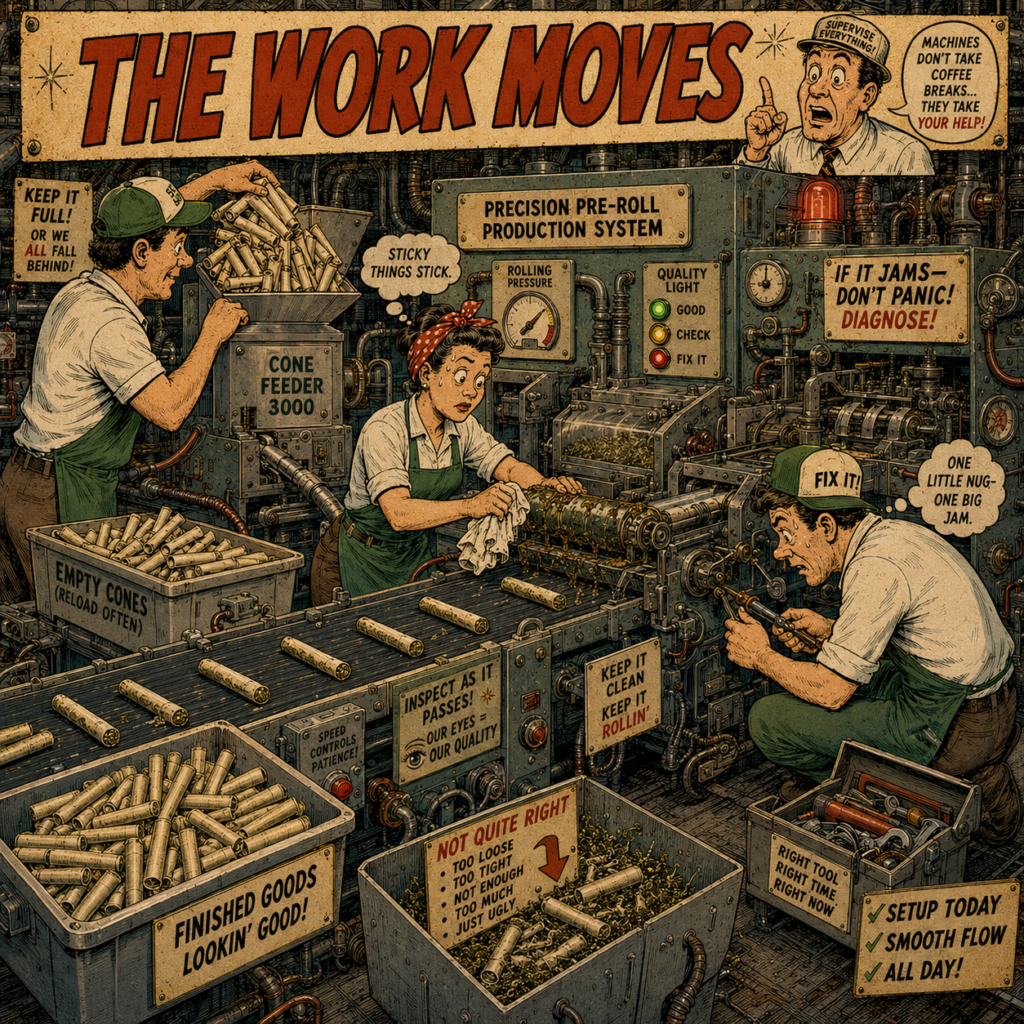
A machine that fills cones still needs people.
Futurola’s own two-operator workflow makes that unusually easy to see.
One person prepares material, measures the mix and runs the filling stage. A second loads cones, closes the finished products and resets the line. Cleaning and replenishment sit between production cycles.
Higher automation can reduce repetitive hand work while increasing the need for operators who understand the material and the equipment.
The work moves.
A person who once spent a shift filling individual cones may spend more time preparing material, keeping equipment supplied, checking output, cleaning contact surfaces and dealing with exceptions.
Machines like sameness. Cannabis supplies variation.
Peak production numbers do not tell an operator how a line performs through an entire shift. Different flower, moisture, grind and cone behavior can still require intervention. Faster equipment can amplify a poor input as efficiently as it amplifies a good one.
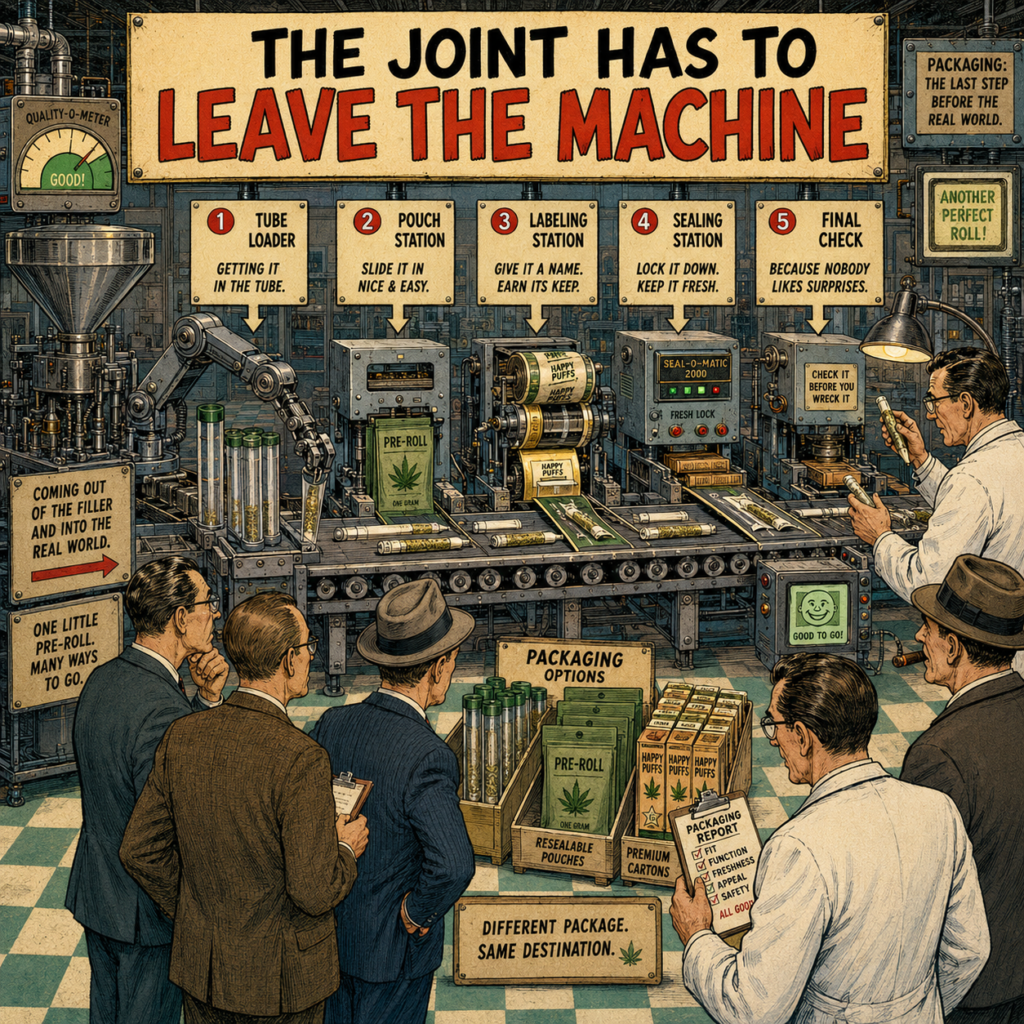
The joint eventually has to leave the machine
Production does not stop when the cone is closed.
The finished pre-roll still needs protection, labeling and a package suitable for the market where it will be sold.
That creates another set of standardized objects for machines to handle.
Chubby Gorilla’s current catalog, for example, includes child-resistant and tamper-evident tubes in several lengths. Hara and MaryJane supply cones at industrial volumes. Futurola supplies machinery around filling and closing. These companies occupy different stages of what is becoming a more organized manufacturing chain.
A machine has to orient the pre-roll, place it into a tube, pouch or carton, close the package, inspect it and move it onward without turning every exception into a stoppage.
The joke is becoming an industrial category
The phrase “robot-rolled joint” works because everyone can picture it.
The accurate version is more useful.
Automated machines are already performing several of the jobs required to make a modern pre-roll. They prepare flower, fill cones, control density, handle batches and close finished products. People keep the line supplied and deal with the cases the equipment cannot absorb.
That is how factory automation usually arrives.
The machine does not replace the craft in one leap. Engineers divide the work into jobs, control the jobs that can be controlled and leave people around the places where material and reality refuse to behave exactly the same way twice.
The cartoon of a robot rolling a joint is less useful than the production line that already replaced much of the motion.
Sources
- Futurola, Commercial Pre-Roll Production System.
- Futurola, KnockBox 100 pre-roll filling system.
- Softrim – Platform Robotics
- Futurola, Pre-Roll Equipment for Business Production.
- Hara Supply, pre-rolled cone manufacturing and quality-control information.
- MaryJane Cones, pre-rolled cone products and manufacturing information.
- Chubby Gorilla, current tube packaging catalog.
- Sun, T., Plommer, H., Shah, S., & Roggen, M. “Does Size Matter for Performance? A Study of How Particle Size Influences Joint Smoking.” Cannabis Science and Technology, 17 April 2023.
- Justice, A., Kirk, R., Manning, A., Roggen, M., & Shields, M. “Impact of Water Activity on the Chemical Composition and Smoking Quality of Cannabis Flower: The Science of Smokability Phase I Results.” Cannabis Science and Technology, 8(2), 10–19, 2025.
This article reports the technology as it stood in August 2026.
Editor’s note
No peer-reviewed study of automated pre-roll production quality across cannabis cultivars has been published.