Can Software Really Predict Your Harvest? A Healthy Dose of Skepticism
Yield prediction tools promise to tell you your harvest weight weeks in advance. The technology is real. The claims deserve more scrutiny than they usually get.
A growing number of cultivation technology platforms now offer yield prediction: software that claims to tell you how much a room will produce, weeks before harvest, based on current growth data. Some vendors report accuracy numbers in the 90s.
Those numbers are genuinely impressive when they’re real. They’re also the kind of headline figure that deserves a closer look before it shapes a business decision.
What’s actually happening technically
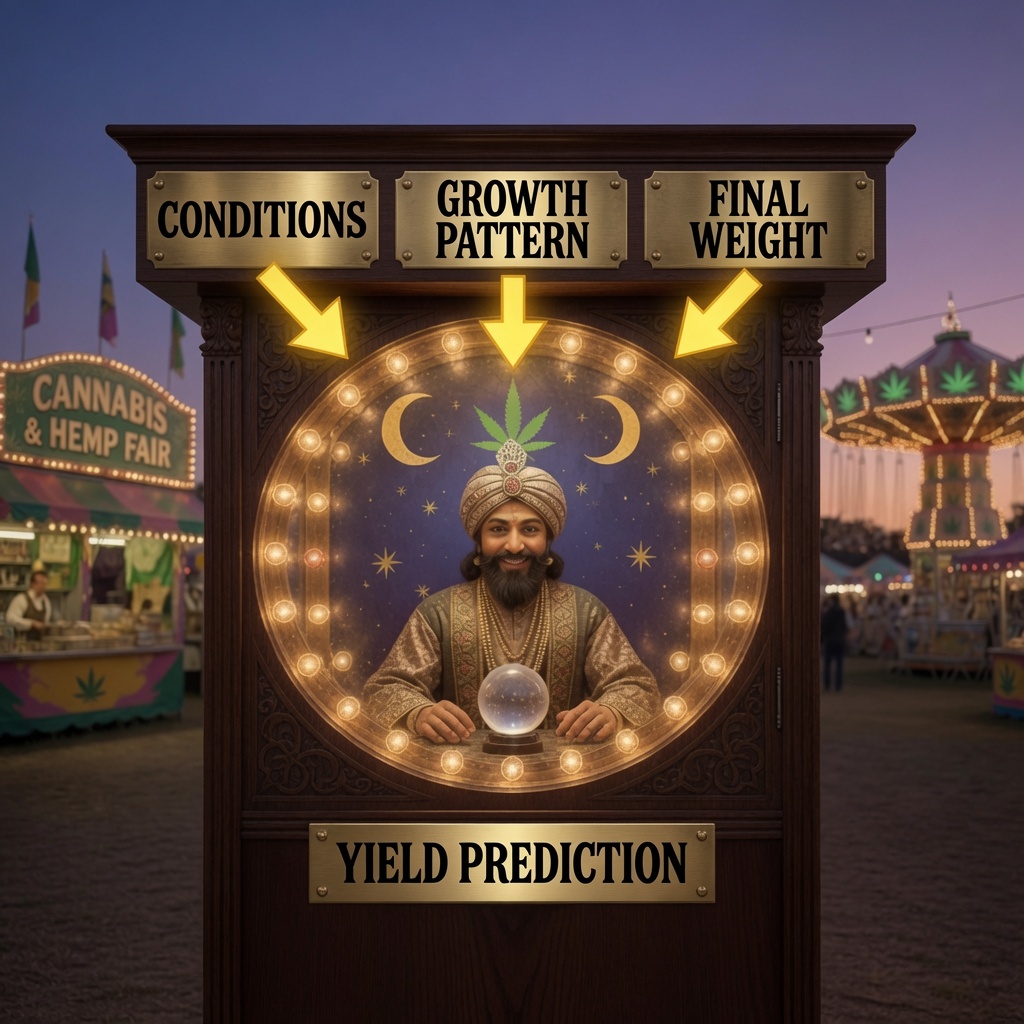
Yield prediction models are built on machine learning, trained on historical data about how plants grew, what conditions they grew in, and what they eventually yielded. Feed a model enough of these three legged stories, conditions, growth pattern, final weight, and it starts finding patterns that let it guess the ending of a new story it hasn’t seen the end of yet.
This works well when the new story closely resembles the ones the model already learned from. It works less well when it doesn’t.
Why cannabis makes this harder than it sounds
Here’s the honest complication. Cannabis has an enormous number of distinct genetic lines, and they don’t all grow the same way. A model trained mostly on data from a handful of common, widely grown strains has a lot of examples to learn from for those strains specifically. Point that same model at a newer or less common strain, one it has seen only a handful of times before, and its confidence should reasonably drop, even if the vendor’s headline accuracy number doesn’t change.
This is the same reason a weather forecaster is more confident predicting tomorrow’s temperature in a city with a hundred years of recorded data than in a location that’s barely been tracked for a season. More history means more confidence. Less history means more guessing dressed up as a number.


The question that actually matters more than the headline accuracy figure
If a vendor tells you their system is 90 percent accurate, or 95 percent, the useful follow up isn’t to doubt the number outright. It’s to ask what that number is an average of. Accuracy across which strains? Across how many total data points? And critically, what’s the accuracy specifically on the strains you actually grow, especially if any of them are newer or less widely cultivated?
A vendor with a genuinely strong product should be able to answer this breakdown clearly. A vague answer, or one that avoids getting specific about strain level performance, is itself useful information.
What good skepticism looks like in practice
This isn’t an argument against yield prediction technology. The underlying approach is sound, and it’s likely to keep improving as more cannabis specific data accumulates across the industry over time. It’s an argument for treating a headline accuracy number the way you’d treat any single statistic pulled out of context: potentially true, definitely incomplete, and worth a follow up question before it changes how you plan your season.
Ask for the strain level breakdown. Ask how the number was calculated and over what time period. Ask what happens to the prediction’s confidence when the system encounters a strain it has limited data on. If a vendor answers all three clearly and specifically, that’s a good sign about the product, regardless of what the headline number turns out to be.

The takeaway
Yield prediction is a real and improving category of cannabis technology. But like most AI powered claims, the honest version of the story lives in the details underneath the headline number, not in the number itself. Operators who ask the right follow up questions get a much clearer picture of what they’re actually buying than the ones who don’t.
cannAItech explores practical future technology for regulated cannabis markets.